Signature Seperated Stats
You can find a video tutorial for Signature Seperated Stats ▶ here.
A Signature Separated Stat is a container Stat that holds multiple child Stats.
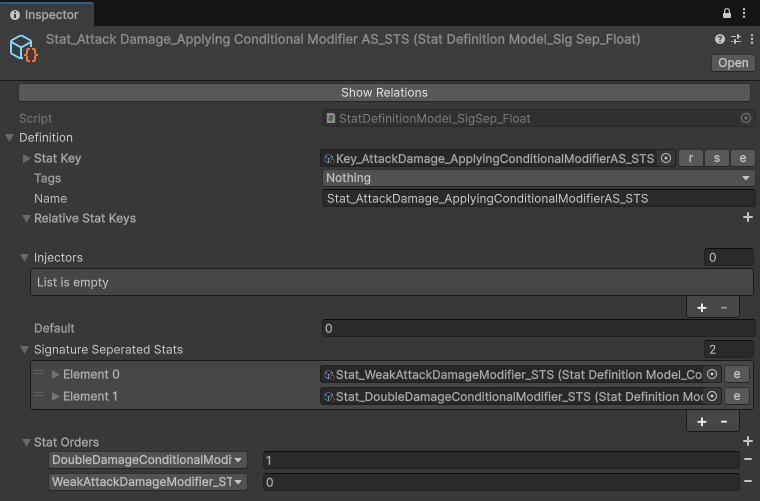
During the Effect processing flow, these child Stats are retrieved according to their configured processing order and processed by the corresponding Signature Separated Processors.
This allows multiple Stats to participate in the same processing stage while keeping each Stat's definition and behavior independent.
For example, suppose a PhysicalAttack Stat has two different reflection mechanics:
- HealthSteal, which restores a portion of the dealt damage as Health to the attacker.
- DamageReflect, a debuff that causes half of the dealt damage to be reflected back to the attacker.
Both mechanics must run during the Reflect process. However, PhysicalAttack can reference only a single Reflector Stat, and creating a separate Relative Stat for every Reflector is not a scalable solution.
A Signature Separated Stat solves this problem by grouping the required Reflector Stats under a single container. In this example, HealthSteal and DamageReflect can both be stored inside a PhysicalAttackReflector Signature Separated Stat. Each child Stat keeps its own independent definition, and the Signature Separated Reflect Processors execute them one by one according to their configured processing order.
 Reflect Process
 PhysicalAttackReflectorSignature Separated StatHealthStealOrder 1DamageReflectOrder 2
Fields
| Field | Description |
|---|---|
| Signature Separated Stats | The list of child Stats contained by this Signature Separated Stat. |
| Stat Orders | Defines the order in which the child Stats are processed during the Effect processing flow. |
Using Signature Separated Stats
To use a Stat as a Signature Separated Stat, you must use the SigSep version of its primitive Stat type.
For example, if you want to use multiple Reflector Stats for a PhysicalAttack Stat, you should create a SigSep_Float Stat and add the Reflector Stat Definitions to its Signature Separated Stats list. The SigSep_Float Stat must also be placed in a Container_SigSep_Float.
HealthStealReflectorDamageReflectReflectorSigSep_FloatSignature Separated Stats list Container_SigSep_Float
The same rule applies to all Stat types. For example, if you want to use multiple FloatLimiter Stats together, create a SigSep_Float Stat, add the Limiter Stat Definitions to its Signature Separated Stats list, and place it in a Container_SigSep_Float.