Using Conditional Modifiers in Processors
Some Processors expose UseConditionalModifier options. These allow a Stat used by the Processor to be modified dynamically according to the current context before the Processor continues its execution.
Why is this needed?
Consider the following requirement:
+50% Critical Rate against Undead enemies
Normally, the CritHit process reads a single CritRate Stat, which has only one value. That makes it impossible to have different Critical Rate values depending on the current target or other runtime conditions.
By enabling UseConditionalModifier, the Processor first passes the CritRate Stat through a Conditional Modifier. The Conditional Modifier can then adjust the value according to any condition before the Processor uses it.
This mechanism is not limited to CritRate. It can be used for any Processor value such as Hit Rate, Shield, Immune, or any other Stat that supports conditional modification.
How it works
Conditional Modifiers are always resolved through an ASContribution_ConditionalModifier Processor, regardless of which UseConditionalModifier option triggered them — its signature is the one that accepts both a Target Stat and an Attribute Stat.
For a Conditional Modifier, the Effect's real Target Stat is passed through as-is, while the queried Stat — the one whose value needs conditional adjustment, such as CritRate stat for the Crit process, or HitRate stat for the HitRate process — is passed in the Attribute Stat slot.
 Effect's Target StatQueried State.g. CritRate, HitRate
 ASContribution_ConditionalModifier
The resulting Contribution is applied to the queried Stat's current value, and only for this Processor execution — the Stat's stored value is never permanently changed.
In other words, the Stat itself is conditionally modified only for the current Processor execution without permanently changing the Stat.
Example Setup
We will use VenomfangBlade from the 3DCells demo to demonstrate how Conditional Modifiers can be used with the CritHit Processor.
In the VenomfangBlade example, the Conditional Modifier is used to modify the critical hit chance based on the target's Poison stacks.
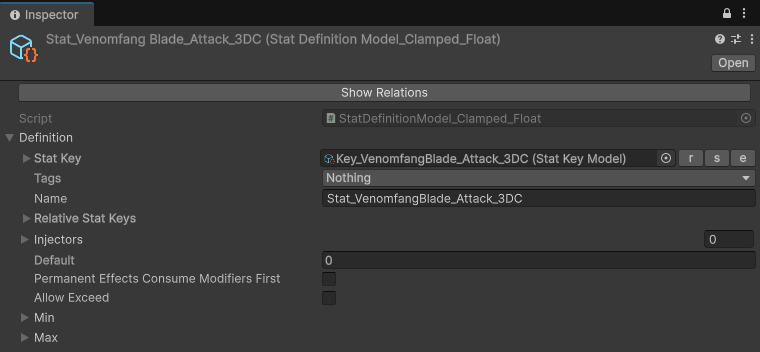
- This is the VenomfangAttack Stat, which is used as an AttributeStat for VenomfangBlade attacks.
-
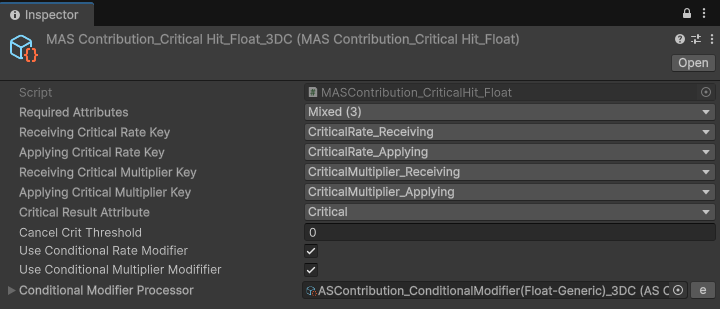
Enable UseConditionalHitRateModifier on the CritHit Processor.
-
Assign an ASContribution_ConditionalModifier_Float Processor reference.
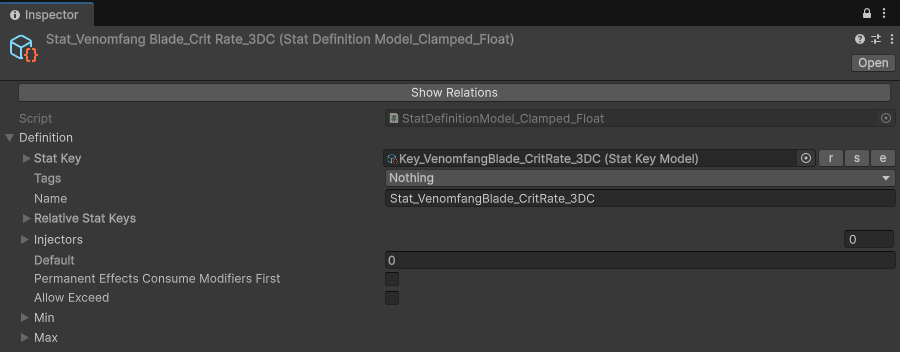
- On the CritRate Stat, assign the ConditionalModifier_ApplyingAS (or ConditionalModifier_ReceivingAS) Relative Stat that will be used during conditional processing.
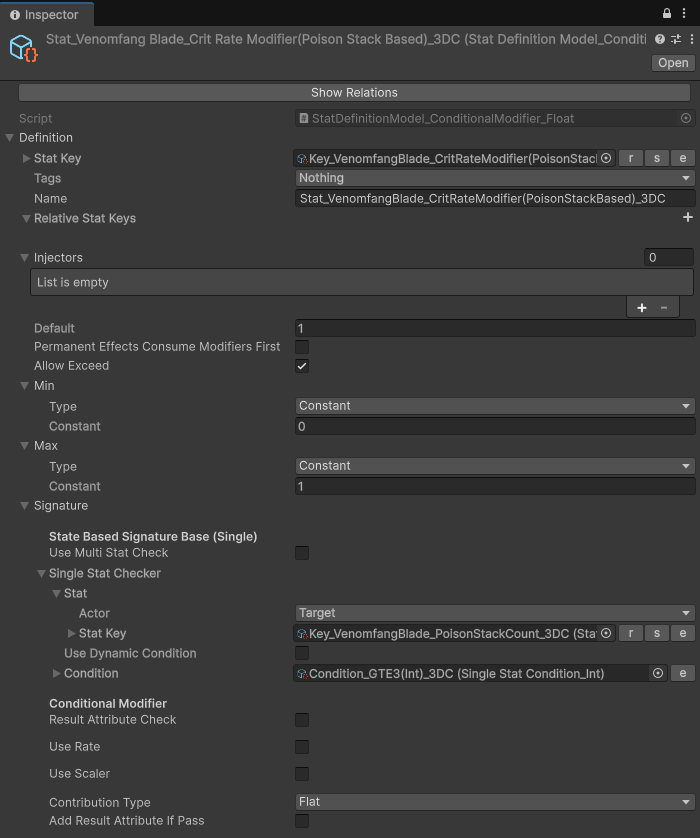
- When the Conditional Modifier's condition is met, the CritRate value will be modified. In this example, 1 is added to CritRate as a flat contribution, allowing the blade to deal critical damage when the target has 3 or more Poison stacks.
If you need multiple independent conditional modification rules, use a Signature Separated Conditional Modifier and its corresponding Signature Separated Processor.